octoscope
What it is
Section titled “What it is”octoscope is a single-binary Go TUI that turns the GitHub API into a live dashboard. It’s structured as a tabbed auto-refreshing layout — Overview, Repos, PRs, Issues, Activity, What's new — addressable by number keys (1–6) or cycled with tab / shift+tab. Each tab carries drill-in detail views, a sortable + searchable list (where applicable), a rate-limit-aware footer, and a live “change pulse” border flash that pulses when new data arrives. Seven built-in themes include phosphor (80s P1/P31 CRT pure green, vt100 vibe) and amber (80s amber CRT, IBM 5151 / WordStar). The fact that amber is one of the named themes is the single most KN-86-aligned detail in the entire inspiration set.
Aspirational features for KN-86
Section titled “Aspirational features for KN-86”amberandphosphoras named CRT themes is direct lineage. octoscope explicitly names its CRT themes after the historical phosphor types — and theambertheme is literally KN-86’s color story. Citing octoscope as the precedent for “amber as a named first-class theme” is fair game. The aesthetic-mode roster sketch in the Batch-2 visual identity brief (AMBER / AMBER / CIPHER) is in lineage with octoscope’sphosphor / amber / monochrometriad.- Tabbed auto-refreshing layout is the right pattern for the Bare Deck Terminal. Six tabs, addressable by number key, each carrying its own surface. Maps almost 1:1 onto the Bare Deck Terminal’s STATUS / CIPHER / LAMBDA / LINK / SYS tabs (
docs/software/runtime/bare-deck-content-brief.md). octoscope is the strongest single contemporary reference for “what a tabbed always-on dashboard TUI looks like in 2026.” - Live “change pulse” border flash. Border briefly brightens/changes color when new data arrives. KN-86 can apply this for: a new CIPHER-line fragment arriving (border on the CIPHER tab flashes), a mission becoming available, a dispatch transmission landing, a battery threshold crossing. Tiny affordance, big payoff for “the device feels alive.”
- Rate-limit-aware footer. The footer shows how many GitHub API calls are left in the current rate-limit window. Honesty about the device’s resource state, in-band, always visible. For KN-86 the equivalent is the Row-0 status strip showing battery / coprocessor link / cart state — already canonical, but worth noting octoscope as a parallel: surface state where the user can see it without asking.
- Theme list that explicitly includes a
terminaltheme (inherits from the host emulator’s ANSI brights) is a small but tasteful design move. KN-86’s desktop emulator could plausibly ship ahost-terminalaesthetic mode that defers to the user’s iTerm/Alacritty/Ghostty palette — useful for screenshot-and-share, useful for accessibility (high-contrast palettes the user already prefers). Not v0.1; park. - Drill-in detail views. Each list-item-in-a-tab opens a detail surface in the same tab when activated. The pattern matches the master/detail reference from golazo and is reinforced here at scale (lots of tabs, lots of details).
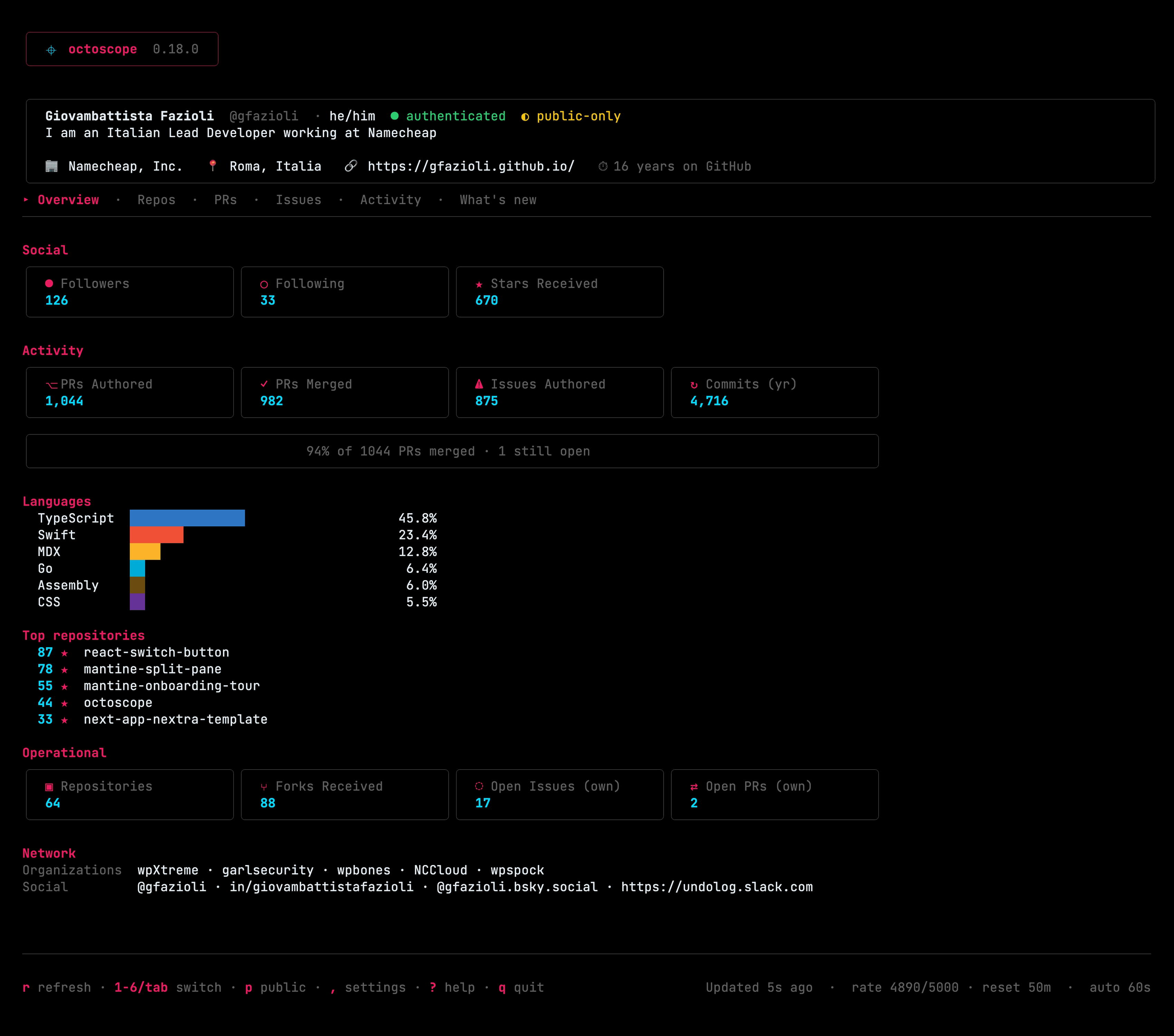
Source: octoscope docs/screenshots/screenshot.png. Shows the Overview tab with the five stat sections (Profile, Social, Activity, Operational, Network) and the tab strip.
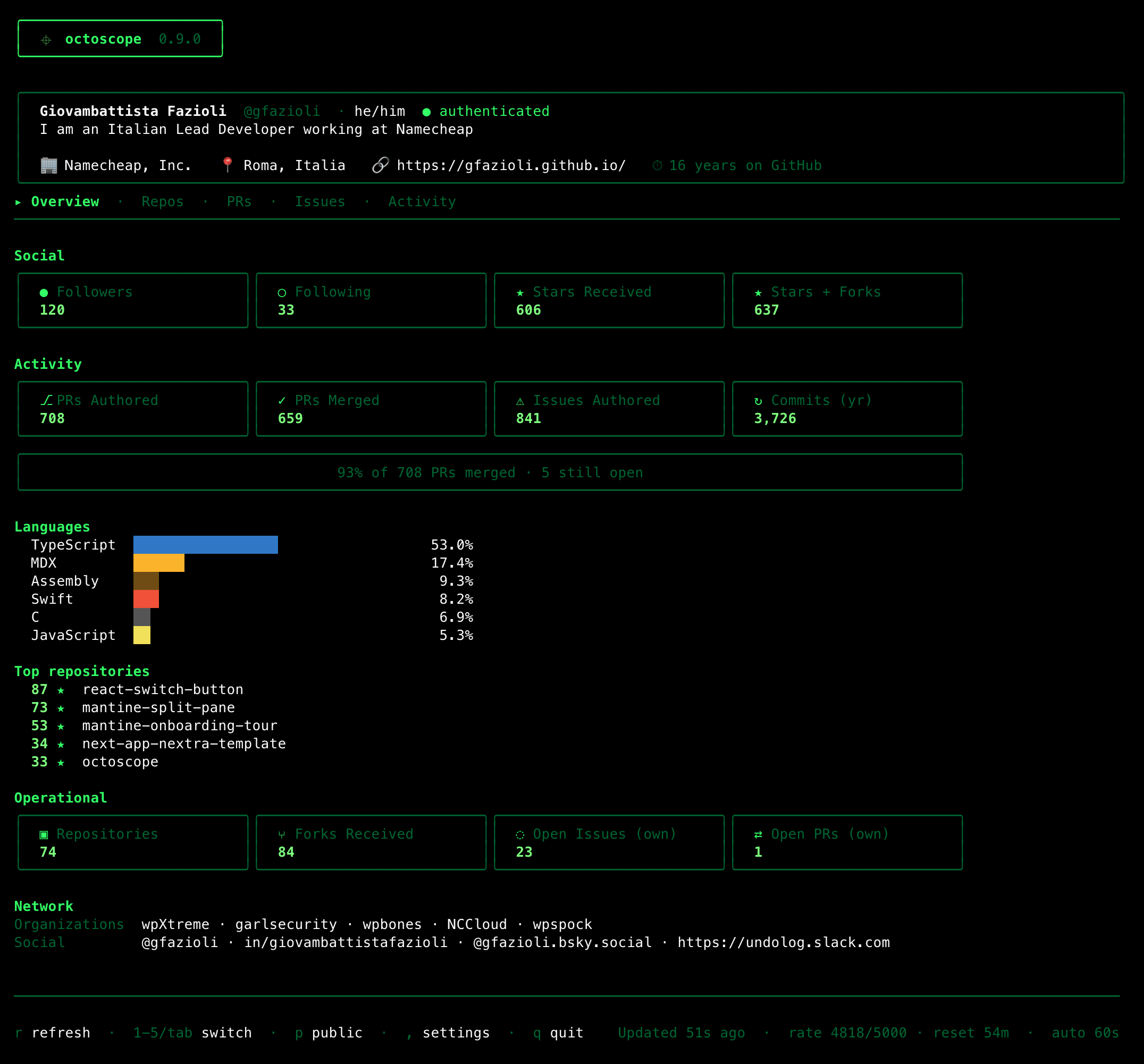
Source: octoscope docs/themes/theme-phosphor.png. The 80s P1/P31 phosphor green theme — KN-86 is the amber sibling of this aesthetic, deliberately.
- The single strongest direct lineage for KN-86’s
AMBERaesthetic mode. Worth a paragraph cite when scoping the aesthetic-mode roster. - Tabbed auto-refresh + drill-in + change-pulse is the right architectural reference for the Bare Deck Terminal. Read octoscope’s source if/when implementing that surface.
- Cross-link netwatch.md for the other strong tabbed-dashboard reference. Both are tab-strip-up-top + content-below; NetWatch uses digit-key tabs (1–9), octoscope uses digit-key tabs (1–6); both are right for KN-86’s phone-numpad input model.
- Cross-link bubble-tea.md and lip-gloss.md — octoscope is a Charm-stack reference architecture worth studying when KN-86 commits to that path.