QRPπ
What it is
Section titled “What it is”QRPπ is an all-in-one weatherproof digital-mode amateur radio deck built into a Pelican 1170 case. The hard case is the chassis; everything else — keyboard, screen, Raspberry Pi, ATU-100 HF tuner, DRAWS radio hat, GPS, audio jack — mounts to three custom 3D-printed inserts: a bottom keyboard insert (carries the ortholinear keyboard and touchpad), a top insert panel (carries connectors, antenna passthroughs, two DIN ports, a 3.5 mm audio jack), and a screen bezel that retains and protects the 7.8″ e-ink display in the lid. The whole assembly is one of the canonical “Pelican-case cyberdeck” builds — a working, portable, weatherproof radio station rendered as a single artifact.
For KN-86’s purposes this is the prototype reference — the closest single existing build to what the Deckline hardware needs to be.
Key takeaways for KN-86
Section titled “Key takeaways for KN-86”- Pelican 1170 as the chassis is a validated decision. Canonical Hardware Specification (
kinoshita/CLAUDE.md) already commits to a Pelican 1170 Protector Case for KN-86. QRPπ is one of the strongest existence proofs that this case works as a real, portable, weatherproof field deck. Not a brittle maker-fair concept — a built, used, documented build. - Three-insert structure is the right print layout. Bottom (keyboard plate), top (port panel), bezel (display retainer). KN-86’s inserts are slightly different — primary display bezel, CIPHER-LINE OLED bezel above the keyboard, key plate, cartridge-slot retainer, port cutouts (per Canonical Hardware Spec) — but the pattern (three to five 3D-printed inserts seated into the Pelican foam, the foam carrying the components, the case unmodified) is the same. QRPπ is the build template.
- The Pelican shell is not machined. QRPπ leaves the Pelican case itself untouched — no drilling, no cutting, no compromised seal. All modification is in the printable inserts. This is the right design constraint to commit to for KN-86 — keeps the case warranty-equivalent, makes the build reversible, and means the user can crack open the case for service.
- Ortholinear keyboard in a Pelican is a working pattern. QRPπ uses an ortholinear key plate seated in a printed insert; KN-86’s 31-key phone-numpad + 14-FN + TERM layout (ADR-0018, ADR-0024) is structurally similar (PCB seated against a printed bezel). Direct prior art.
- Display in the lid is the canonical layout. Screen retained by a bezel in the Pelican lid; everything else in the body. KN-86 follows this exact pattern — primary display in the lid, CIPHER-LINE OLED mounted above the keyboard in the body, all per Canonical Hardware Spec.
- Foam-cut-to-component is part of the design. Pelican cases ship with pluck foam; QRPπ exploits that. The KN-86 build should similarly use the Pelican foam to seat the Pi Zero 2 W, the Pi Pico 2 coprocessor, the LiPo battery, and the cabling — printed inserts handle the user-visible surfaces, foam handles the internal volume.
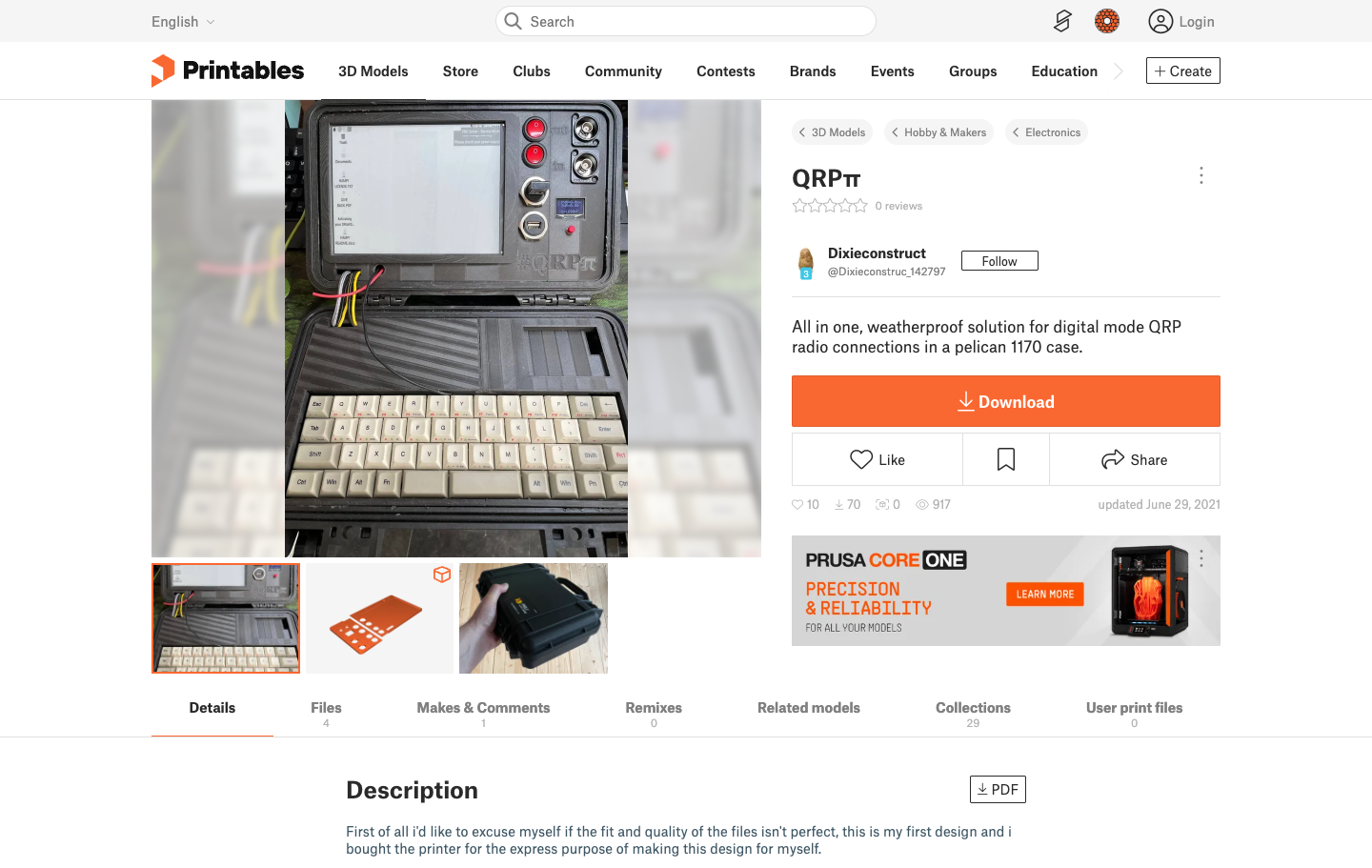
The Printables product page hero shot: open Pelican 1170, ortholinear keyboard + touchpad in the bottom insert, 7.8″ e-ink screen in the lid, radio modules and connectors visible around the periphery. The structural template KN-86 should follow almost line-for-line, with KN-86’s component set substituted in.
- Direct cite candidate for the KN-86 hardware build specification. Worth linking from
docs/device/hardware/build-specification.mdas the closest existing build the spec is descended from. - Different display tech (e-ink vs. IPS). QRPπ uses a 7.8″ e-ink for battery life on a radio op; KN-86 uses the canonical 7″ Elecrow IPS 1024×600 (per Canonical Hardware Spec) for the cyberpunk-amber aesthetic. The mounting/bezel pattern transfers; the panel tech doesn’t.
- Same processor family (Pi). QRPπ uses Pi 3B + DRAWS; KN-86 uses Pi Zero 2 W + Pico 2 coprocessor. Form-factor delta is small; thermal envelope is more constrained on the Pi Zero (good — less heat to manage).
- Open question — keyboard tilt angle. QRPπ’s photo shows the keyboard sitting near-flat in the case bottom. KN-86 might benefit from a slight angled tilt (5–10°) toward the operator; worth prototyping both. Park for the print-models / bring-up phase.