x0xb0x Synth Kit
What it is
Section titled “What it is”x0xb0x is a DIY analog-synthesizer kit — specifically a TB-303 clone — designed by Limor Fried (Ladyada) and distributed through Adafruit Industries as a bare-PCB pair. Builders source the analog components (CEM/SSM-equivalent op-amps, panel pots, mechanical switches, the actual chips that go on the boards) separately and assemble the synth themselves. The whole project is in lineage with the early-2000s DIY-electronics renaissance — open schematics, community build documentation, replicable bills of materials, and the resulting hardware is the user’s own to repair, modify, or modify-by-replacement.
For KN-86’s purposes this is a lineage / posture reference, not a feature reference. The Adafruit / Ladyada open-hardware ethos is a directly KN-86-relevant ancestor.
Aesthetic / design inspiration for KN-86
Section titled “Aesthetic / design inspiration for KN-86”- DIY-kit ethos. Buy a board, build the instrument, own it forever. The opposite of locked, encrypted, no-user-serviceable-parts consumer electronics. KN-86’s cartridge-as-artifact decision (ADR-0019 — physical openable sled containing an SD card the user can read, write, replace) is squarely in this lineage. The whole Deckline should be repairable, hackable, modifiable; the bill of materials should be public; the firmware should be flashable from a standard SD card; the case should be openable without breaking a seal.
- Panel / PCB aesthetic. The x0xb0x panel is unapologetic about being a PCB — silkscreen labels, exposed traces, knurled potentiometer shafts, hardware switches that click. KN-86 sits in the same aesthetic family — visible fasteners, deliberate hardware texture, no hidden internals. The Cyberdeck Cafe (./cyberdeck-cafe.md) tactical-cyberpunk lineage is the same posture from a different angle.
- Ladyada / Adafruit as the lineage ancestor. Adafruit’s whole catalog is open-hardware-friendly DIY electronics. KN-86’s marketing should consider Adafruit’s audience as adjacent — the people who buy a x0xb0x kit are the people who would buy a Deckline. Worth a marketing-plan citation.
- Components sourced separately is a feature. The user is in control of the build. They can substitute parts, they can deviate from the BOM, they can repair with whatever they have on hand. KN-86 doesn’t ship as a parts kit (the Pelican-1170 build is more integrated than that), but the published BOM + buildable-from-instructions documentation should be a real deliverable — see
docs/device/hardware/build-specification.mdanddocs/device/hardware/sourcing-guide.md. - TB-303 specifically as the music-hardware lineage. The TB-303 is one of the most-cloned, most-modified, most-loved pieces of music gear in history precisely because it was an underspecified, slightly broken, but distinctive-sounding instrument that found its identity in the hands of users who were not the originally intended audience. The KN-86 hardware/firmware is being designed with deliberate constraints (monochrome amber, fixed grid, embedded Lisp); the lesson from the TB-303 / x0xb0x lineage is that constraints are how a device acquires identity.
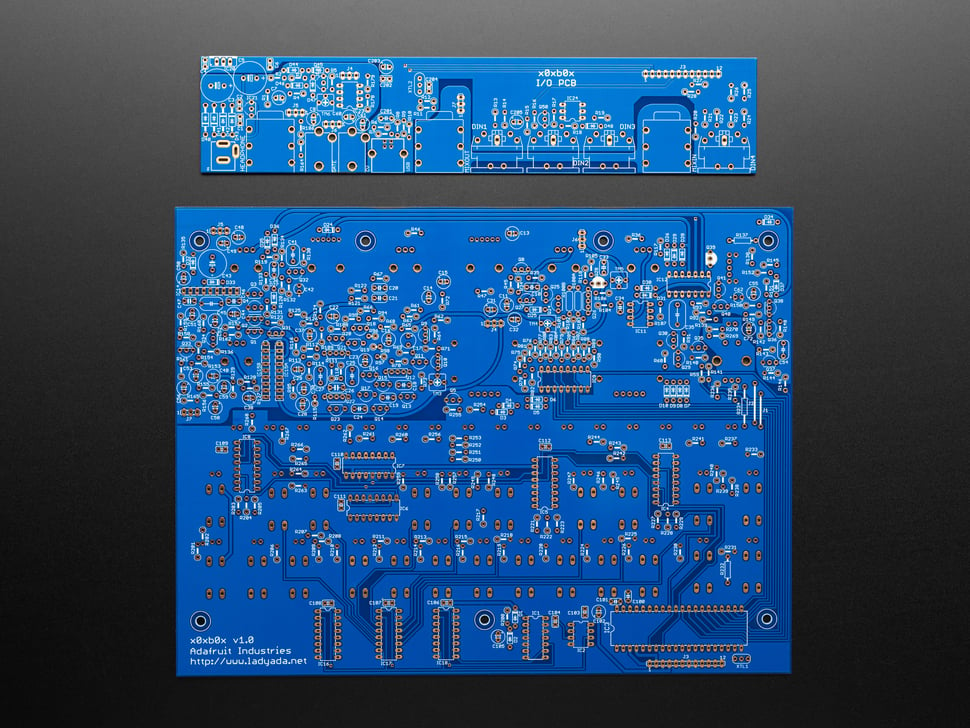
Source: Adafruit product image cdn-shop.adafruit.com/970x728/3603-02.jpg. Shows the bare PCB pair as sold — mainboard with control-surface panel cutouts, I/O board with rear-panel jack positions, all silkscreened with component references and Ladyada’s signature design language.
- Pure reference; do not order. Per the prompt, the Adafruit product page is for visual / lineage reference only, not for actual purchase. The KN-86 BOM does not include a x0xb0x.
- Cross-link 4trk.md — software analog to the same retro-music-instrument aesthetic.
- Cross-link cyberdeck-cafe.md — same DIY / open-hardware community posture, different domain.
- The deeper lesson is “ship hackable hardware.” KN-86 should reach a point — by v1.0 or shortly after — where an enthusiast can read every byte of the firmware, edit every cart in nEmacs on the device, swap any electronic component on the BOM with a published equivalent, and re-flash the system image from a standard SD card with no special tooling. The x0xb0x is the spiritual ancestor of that commitment.